


How EIHL playoffs compress a season into one weekend — and what that does to the market
The EIHL playoff weekend in Nottingham is the strangest betting event in UK domestic sport, and I mean that as a compliment. A full season’s worth of competition collapses into four matches across 48 hours — two semifinals on Saturday, a third-place game and a final on Sunday. The compressed format produces market behaviour that doesn’t appear anywhere else in hockey betting. Lines move on warm-ups. Goalie news lands an hour before puck drop and reshuffles the whole card. The volume, by NHL standards, is small. The pricing inefficiencies, by NHL standards, are large.
EIHL playoffs betting covers the postseason structure of the Elite Ice Hockey League, the UK’s top domestic professional ice hockey competition. The format runs in two stages: a quarter-final round played in late March or early April, contested as two-leg series between the regular-season top eight, and the playoff weekend at Nottingham’s Motorpoint Arena in mid-April, where the four quarter-final winners meet in single-elimination semifinals on Saturday with the final played on Sunday afternoon.
For UK punters, the EIHL playoffs are the cleanest domestic hockey-betting product available. The matches are in UK time, the broadcast is accessible, and the betting market is open at most UKGC-licensed operators. The structural quirks of the format — short series, neutral-venue weekend, compressed schedule — produce pricing patterns that reward punters who understand how the market builds and where the public money lands.
The format and how it builds toward Nottingham
The EIHL regular season runs from late September through mid-March, with each team playing 54 league fixtures. The top eight teams in the final standings qualify for the playoffs. Belfast Giants finished the 2025-26 regular season with 84 points across 54 matches and a goal differential of +85, claiming their 8th regular-season title — the kind of dominant regular-season performance that anchors playoff favourite pricing.

The quarter-final round is contested in early April as a two-leg series. Each tie is best-aggregate-score across two games, one at each team’s home venue. The series with the higher aggregate score advances; tiebreakers resolve through overtime if the aggregate is level after 120 total minutes of play. The two-leg format means a quarter-final win requires winning the aggregate, not winning either individual game outright — a team can lose a leg and still advance.
The playoff weekend is the structural showpiece. The four quarter-final winners gather at Nottingham’s Motorpoint Arena for single-elimination semifinals on the Saturday — two matches across the day. The two semifinal winners contest the final on Sunday afternoon; the two losers play a third-place game earlier on Sunday in some seasons, or skip it entirely in others depending on the league’s calendar.
The arena itself is part of the product. Motorpoint Arena holds approximately 10,000 spectators when configured for hockey, and the playoff weekend regularly sells out. The atmosphere — partisan crowds from across the league converging on a neutral venue — is the most distinctive aspect of UK domestic hockey, and it creates a betting environment unlike the NHL’s home-and-away rhythm. There’s no genuine home-ice advantage in Nottingham unless you’re Nottingham Panthers themselves, and even then the visiting support is significant.
The single-elimination structure changes the variance profile. A regular-season EIHL match has 60 minutes of play plus possible overtime and shootout. A playoff weekend match is the same length, but with the entire season’s outcome riding on a single result. Coaches manage the bench differently. Goalies rotate less. The intensity creates a different statistical profile than the league’s regular-season games.
The outright market
EIHL playoff outright markets open at most UK books in early March, as the regular-season standings clarify and the quarter-final matchups become visible. The market closes when the Sunday final concludes. Pricing across the field clusters between 2.5 and 8.0 for the contenders, with the dark-horse positions running to 15.0 or longer.
The 2025-26 EIHL season set a new league attendance record at 1,321,128 total spectators across the regular season, averaging 3,863 per game — both league records. The financial scale of EIHL is modest compared to the NHL, but the attendance growth signals genuine commercial momentum, and the betting market has scaled with it. UK books that didn’t carry EIHL outright markets five years ago now offer them across the playoff weekend.
The structural pricing logic: the regular-season champion is usually the playoff outright favourite at 2.5 to 3.0, but the favourite price overstates the actual win probability. EIHL playoffs are high-variance because the matches are short, the quarter-final two-leg format produces upsets, and the playoff weekend itself condenses two single-elimination matches into 24 hours. A regular-season champion with 84 points wins the playoffs roughly 30 to 35 percent of the time historically, but the market often prices that probability at 35 to 40 percent.
The structural value spots are usually the third or fourth seed in the playoff bracket. These teams have demonstrated regular-season competence — top-half finish — but the public weight loads onto the top one or two seeds. Pricing the third seed at 5.0 in a four-team weekend is often a more realistic implied probability than pricing the top seed at 2.5.
Playoff weekend arena: neutral venue dynamics
Nottingham as a neutral venue produces a betting dynamic unique to the EIHL playoff weekend. Unlike NHL playoffs where home-ice advantage runs through every series, the EIHL playoffs are decided on neutral ice (except for the home team itself, when Nottingham Panthers qualify).
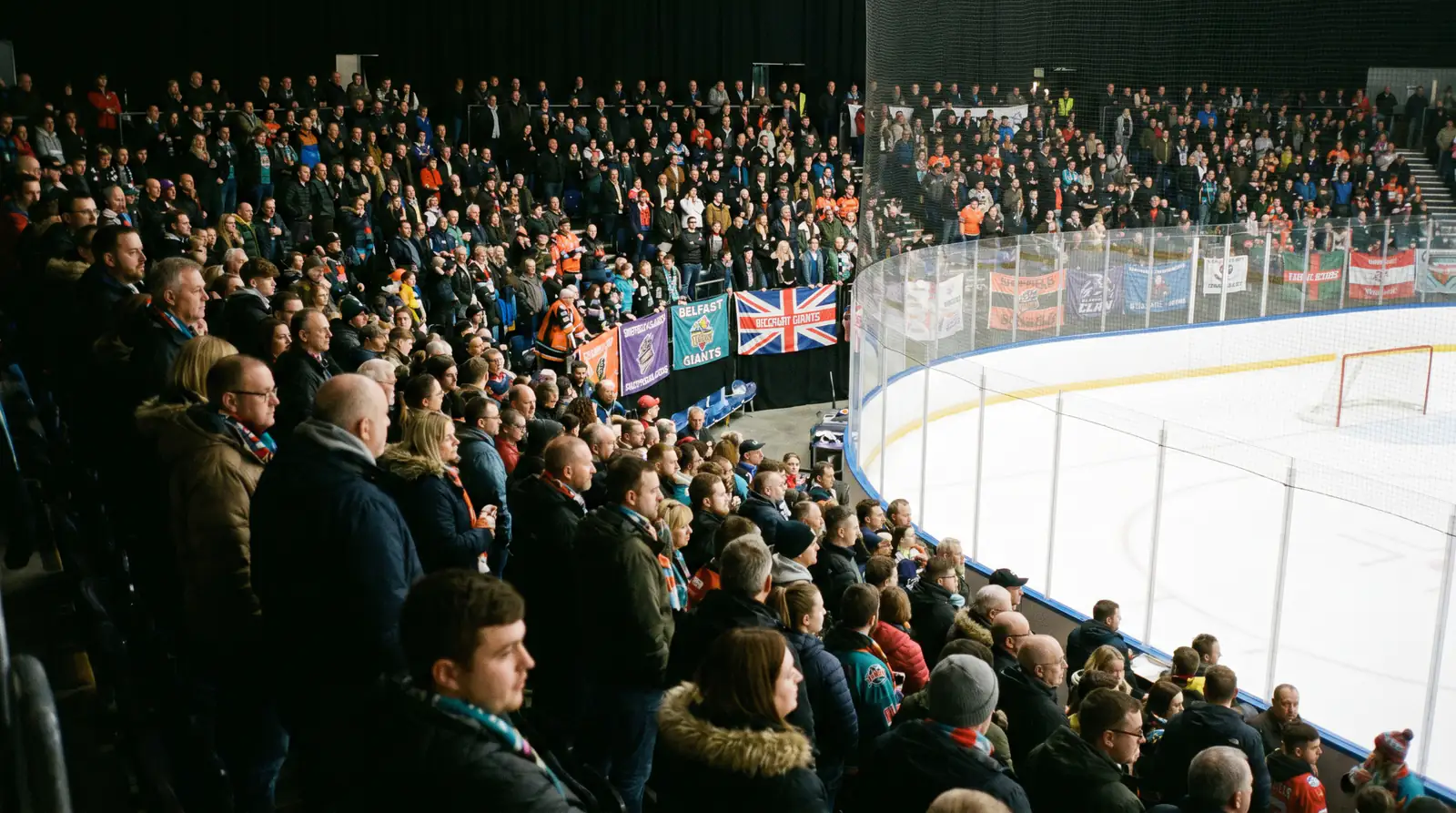
The neutral-venue dynamic has two betting implications. First, the home-ice statistical adjustment that drives most NHL playoff models doesn’t apply. A team that performed better at home than on the road during the regular season loses that advantage at the playoff weekend. Models that include home-ice premium overstate the favourite price for teams whose regular-season strength was home-skewed.
Second, the travel and venue factors equalise. All four teams arrive at Nottingham on Friday or Saturday morning, play on Saturday, and the survivors return on Sunday. The travel-load and venue-familiarity factors are essentially the same for every team. The advantage shifts to teams whose playoff weekend rosters are healthiest — injury management across the regular season matters more than venue factors.
Sheffield Steelers were the most-attended EIHL team in 2024-25 with average gates of 7,978, hitting a season-record 9,638 on 26 December 2024 against Nottingham Panthers. That attendance scale tells you something about the depth of EIHL support outside the playoff weekend, and the conversion of that regular-season fanbase to playoff weekend travel is what fills Motorpoint Arena. Teams with strong fanbases bring the loudest support to Nottingham, which produces a quasi-home atmosphere on the ice even on neutral venue.
The pricing implication: factor in fanbase travel when assessing the implied home-ice equivalent. Belfast Giants travelling with 2,000+ supporters effectively converts Motorpoint into a partial home game for them, which marginally affects the matchup dynamics. The model adjustment is small but real.
Live betting availability
Live betting on EIHL playoff weekend matches is available at most tier-1 UK books, though the depth is materially thinner than NHL live coverage. Live moneyline and live total are the standard markets. Live props are rare — anytime goalscorer might be available, shots on goal props almost never are.

The latency on EIHL live markets is also higher than NHL. The data feeds that drive NHL live pricing — including NHL EDGE telemetry from arena infrared cameras — don’t have direct EIHL equivalents. UK books pricing EIHL live markets work from broadcast feeds and basic event data, which produces slower line moves and occasional pricing lag.
The implication for in-play betting: the EIHL live market is a less efficient version of the NHL live market. Pricing lags create occasional value windows after a goal but before the model has updated. Sharp punters can exploit these windows, but the limits are modest and the position sizes can’t scale as freely as on NHL.
The pillar product the playoffs sit inside
The EIHL playoff weekend is the culmination of the regular-season betting cycle, and the regular-season market shape — moneyline patterns, totals tendencies, props depth — feeds into how the playoffs are priced. The full breakdown of how EIHL betting works across the regular season, where the market structure differs from the NHL, and which factors drive consistent pricing inefficiencies sits in our EIHL betting guide.

Articles
Prepared by the hockeybetonline.com editorial staff.
