


NHL betting from the UK without the time-zone trap
My first NHL bet from London settled at 04:17 BST on a Wednesday, and I missed the goal that decided it because I had fallen asleep at the 1–1 mark in the second period. Eleven years later, that’s still the single most important thing I tell anyone starting NHL betting UK from this side of the Atlantic — the bet doesn’t move because you’re tired; the bet moves because you stopped watching at the wrong period. Everything else is detail.
The NHL is a 32-team North American league split across the United States and Canada, running a regular season from early October to mid-April followed by a four-round playoff that ends in mid-June with the Stanley Cup. For a UK punter, the mechanics of an NHL bet are technically identical to those of an American one — same markets, same settlement rules, same vig on most lines. What separates us from a guy in Boston is the wrapper: I have to bet through a UKGC-licensed book, my live-betting window is squeezed by puck drops that land between 00:00 and 04:00 BST, and my view of the game comes through a patchwork of Premier Sports, ITVX and increasingly DAZN rather than ESPN or TNT.
Those three constraints — licensing, scheduling, broadcast — sound like minor logistics. They are not. They reshape which markets you can actually play, when you can place a bet with usable information, and how much of the line is moving before your London evening even starts. This guide walks through the NHL board the way I read it from a desk in the wrong hemisphere: what’s priced, what’s moving, what’s catching, and where the rest of the article tree picks up the deeper threads.
The shape of the NHL product: revenue, ratings and market depth
Here’s a counter-intuitive truth that I wish someone had told me before I started: the size of a league’s revenue base directly predicts how deep your sportsbook’s market tree will go. Big leagues get the algorithmic love. Small leagues get a moneyline and a total and a polite shrug.
The NHL had a Hockey Related Revenue of $6.5 billion in 2024–25, up from $6.3 billion the year before. Bettman has publicly placed the 2025–26 valuation in the $7.5–8 billion range, which means the league is growing into the same neighbourhood as the Premier League in pure commercial terms, even if cultural reach in the UK still trails by a wide mile. For a UK punter, this matters because revenue scale is what funds the data infrastructure that bookmakers feed off — tracking systems, official statistics, syndication deals. The bigger the league earns, the more numbers leak out, and the more numbers leak out, the deeper the markets a UKGC book will support.
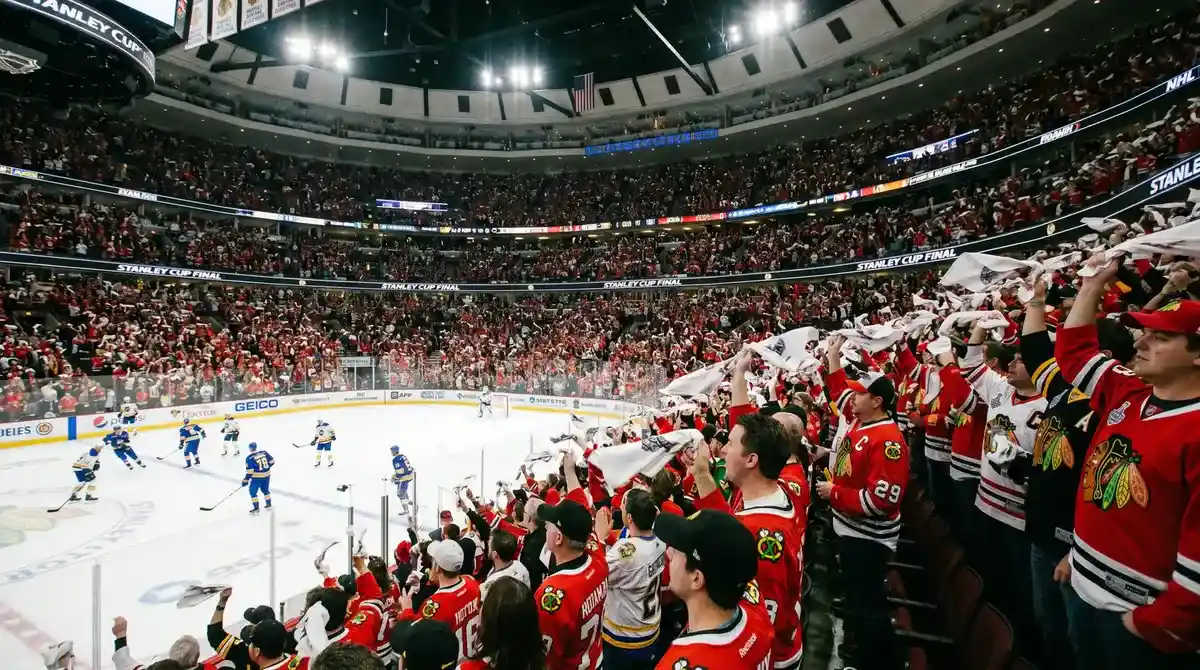
You can see the gap clearly in viewership. The 2025 Stanley Cup Final between Florida and Edmonton drew 2.8 million viewers in the United States for Game 6, with a series average of around 2.5 million. That was down 28 percent year-on-year, but it remains a number that justifies prime advertising slots, which in turn justifies the broadcast partnerships that feed UK screens. Compare the depth of an NHL outright tree on a mainstream UK sportsbook with, say, the depth of an Allsvenskan tree, and you’ll find ten times the player props on one and a single moneyline on the other.
The practical takeaway is uncomfortable for UK bettors who like exotic markets. Almost everything good you can build on the NHL board — props, alt totals, period-by-period markets, Grand Salami — exists because the league earns enough to justify the data engineering behind it. Take that away and you’d be back to picking a winner. So when I’m scoping a UK book for NHL coverage, the first thing I check isn’t the welcome bonus. It’s the prop depth on a random regular-season Tuesday in February. If the props are thin, the rest of the tree is held together with hopes.
And that’s before we get to the third revenue rail, which is sponsorship. Hockey-related sponsorship money keeps flowing into team analytics partnerships that occasionally leak into the public domain — and into the bookmaker pricing models — months before anyone else notices.
Core NHL markets and how they’re priced for UK books
You can play an NHL game on a UK sportsbook with three lines and lose your money efficiently, or you can play the same game with fifty lines and lose it slowly. The trick is knowing which of the three matters before you click anything.
The big three — moneyline, puck line, totals — are the bedrock. Everything else is built on top of them. Specialised cluster articles unpack each market in depth; what follows is the working overview I give to anyone joining the desk.

Moneyline pricing on the NHL
Moneyline is the simplest market: who wins the game. UK books typically settle on the result after overtime and shootout — that’s the two-way moneyline you’ll see most often. A few books also publish three-way moneyline where you pick home win, away win, or tie in regulation time only. The three-way pays more on each side, but you’re now betting against a draw probability that runs around 22–25 percent on a typical NHL matchup, depending on totals expectations.
Vig on standard two-way NHL moneylines on a mainstream UK book sits around 4–5 percent on the implied probabilities for evenly-matched games, widening to 6–7 percent on heavy-favourite spots where the bookmaker hedges against price-sensitive money. That’s tighter than football accumulators by a wide margin, but it’s not free. Implied probability still needs to come in above your model price before the ticket has expected value.
Puck line and the -1.5/+1.5 ceiling
The puck line is hockey’s signature handicap, and unlike a football or NBA spread it almost never moves off ±1.5 goals. The reason is the average game total, which sits in the 5.8–6.2 range across recent seasons — you can’t run a half-goal spread when full goals matter that much, and a two-goal spread would kill the favourite price beyond use. So ±1.5 has become the universal handicap, and the price moves instead of the line.
A heavy favourite at -180 on the moneyline will typically trade around +160 to +180 on the puck line at -1.5, depending on the goalie matchup. A short favourite at -130 might be priced as a -1.5 dog at +210. The puck line is unpacked in granular detail elsewhere; on the NHL board you treat it as a leverage tool, not a default.
Totals in the 5.5–6.5 corridor
NHL totals cluster between 5.5 and 6.5 for the vast majority of regular-season games, with 6 being by far the most common opening number. Lines move on goalie confirmations, on weather (yes, even for indoor games — flight delays and rink-conditions chatter both push totals), on back-to-back rotations, and on early-period scoring patterns once in-play opens. Standard juice is -110 each way, occasionally -115 on the over when public money piles in.
Team totals — over/under on one team’s goals specifically — are pricier in vig and thinner in market depth, but they’re useful for expressing a one-sided view without buying the binary outcome. Where I see UK punters lose money on totals isn’t the line itself; it’s parlaying three or four totals into an accumulator at compound vig and treating the result as a “small bet, big win”. The accumulator is the compound interest of bookmaker advantage.
Stanley Cup and division futures: the long-horizon market
A Stanley Cup outright placed in October is not the bet you think it is. It’s a seven-to-eight-month derivative on a sample of one tournament played by 16 teams, none of whom are remotely the same team at the trade deadline as they were at the season opener. I’ve watched punters back a Cup winner in September and forget the bet existed by March, only to remember in May when the team got eliminated in the first round.
The hold on a pre-season Cup futures market is brutal — typically 30 to 40 percent overround across all 32 teams on a UK sportsbook, against 4–6 percent on a single moneyline. That overround narrows as the season progresses: by the trade deadline in early March, the same book might be running 18–22 percent on the same market, and by the start of the playoffs it could be down to 12–15 percent on the remaining 16 teams. The pricing tightens because the bookmaker has fewer ways to be wrong.
This has practical consequences. Backing a futures market in October means you’re paying the maximum vig the year offers. Backing the same market in March means you’re paying less vig but you’ve also lost the long-shot value that made October interesting in the first place. There’s a sensible middle window — late November to early January, after the first quarter of the season has burned off most of the noise — when the price is partly de-risked but the field is still wide enough to find a 12-1 contender that closes at 7-1 by deadline.
Hedging matters too. A Cup futures bet at 14-1 placed in October, if your team makes the final, can be locked into a guaranteed profit by laying the opposing finalist at the moment the second conference series closes. Edmonton earning around $15 million per game during the 2025 Stanley Cup Final — the highest per-game ticket revenue in hockey history — is the kind of context that gets you to the final, but it doesn’t win you the final. The hedge does.
Division futures and conference futures behave the same way, with tighter hold and shorter horizons. They’re cleaner trades for anyone who wants the long-horizon exposure without the 32-team overround.
What actually moves an NHL line in the 24 hours before puck drop
Roughly 70 percent of the line movement I record on an NHL game between morning skate and puck drop comes down to one event: the confirmed starting goalie. Everything else — schedule, line combinations, weather, public action — is noise around that signal. If you only had time to check one piece of information before placing a bet, it would be the goalie. The fact that most UK punters check the welcome bonus instead is a real, persistent edge for anyone willing to do otherwise.
The confirmation usually lands between 30 minutes and three hours before puck drop, depending on the team and the broadcaster. A backup goalie starting in place of a starter can move a moneyline 30 to 50 cents. A starter confirmed after a precautionary delay can move it back the same distance in ten minutes. UK punters who placed a bet at lunchtime based on assumed lineups have a noticeable disadvantage to anyone betting in the live window — which, on UK time, is exactly the window when most of us are trying to fall asleep.

Late scratches matter too. A top-six winger ruled out at 02:00 BST will shift goal totals by a quarter to half a goal depending on the player. A defenceman ruled out shifts the puck line. Back-to-back schedules — where a team plays consecutive nights — shift everything: goalie totals on the backup, totals on team fatigue, and puck line on goal-differential variance.
The integrity layer underneath all this is professionalised in a way that UK punters often underestimate. Bettman has said the league monitors every minute of every game both in terms of what’s taking place in play and what, if anything, is happening with the lines. That’s not corporate copy. It’s a real surveillance posture that keeps the basis points of public mistrust low and the bookmaker confidence in the product high. The result is a market that bookmakers price aggressively because they trust the data, and a punter who can find edges in the same data if they’re paying attention to the right inputs in the right order.
Which UKGC-licensed books offer the deepest NHL trees
I won’t name a single book here, because the depth of the NHL tree on any given UK sportsbook changes from one season to the next, and the comparative rankings drift even faster. What I will give you is the framework I use when I open a new account.
The first thing to look for is the prop depth on a random Tuesday night game in mid-February — not a Saturday night marquee matchup. If a book runs 40-plus player props on a low-broadcast Tuesday game between two non-playoff teams, the rest of the tree is going to be priced seriously across the season. If the same book runs eight props on the same game, expect a thin moneyline and a buggy in-play feed when you need it most.
The second filter is three-way moneyline coverage. Roughly half of UK-licensed books carry three-way moneyline on most NHL games; the other half publish only two-way. If you want regulation-time markets — and there are situations where three-way is the higher-EV play — the choice of book becomes meaningful. Three-way is also where UK books carry their best NHL value in heavy-favourite spots because the regulation-only constraint isolates a cleaner probability question.
The third filter is in-play availability after 02:00 BST. Some UK books trim their live trader coverage in the early UK morning, which means that during exactly the window where North American sharp money is making its strongest moves, the UK in-play prices either lag or go offline entirely. A book that maintains in-play prices through the third period of an NHL game at 03:30 BST is doing work that the next-door rival isn’t. That’s worth knowing before you wire any money.

Finally, cash-out coverage on futures and prop combinations. This varies wildly. A book might offer cash-out on a single moneyline but refuse it on a same-game parlay of three props; the next book might cash out everything but at punitive haircuts. Test it with a £5 bet before you scale up.
Numbers that punch above their weight on the NHL board
Public NHL analysis still leans on goals, assists and plus-minus, which are the football equivalent of judging a striker on appearances. The bookmaker model leans on something else, and the gap between those two views is where most of the recoverable edge in NHL betting UK lives in 2026.
The three numbers I trust the most are expected goals (xG), PDO, and high-danger Corsi For percentage. Expected goals quantifies the quality of shots taken minus shots faced — a team running an xG percentage of 56 over a meaningful sample is genuinely outshooting opponents in dangerous ways, even if the win-loss record hasn’t yet caught up. PDO combines on-ice shooting percentage and save percentage, and it tells you whether a team’s record is being held up by unsustainable luck on either end of the ice. A PDO of 102 is usually a regression candidate; 98 is usually a bounce-back candidate.
High-danger Corsi narrows the question further by counting only shots from the slot and other prime areas. It’s the closest publicly available proxy to what NHL EDGE measures with hardware — infrared cameras in all 32 arenas tracking millions of data points per season, including shot speed, skating speed and zonal time. EDGE outputs leak into public statistics two to three weeks behind the play; xG and PDO are available next-day from several free sources. That lag is your window.

When a team’s xG percentage and PDO move in opposite directions for ten games — strong xG, weak PDO — you’re looking at a team about to start winning. The bookmaker model knows this, but the public moneyline price often doesn’t. That’s where the soft edges hide on a typical Wednesday.
The 82-game calendar, back-to-backs and what they mean from London
Eighty-two games per team in twenty-eight weeks is more than three per week, and the schedule does brutal things to player legs in ways that the public price often misses. UK punters who only watch marquee matchups never feel this in their bones, but the team that’s flying overnight from Vancouver to Dallas to play the second of a back-to-back is not the same team that played a rested home opener three nights earlier.
Back-to-backs — two games on consecutive calendar days — happen 14 to 16 times per team per season, and the team on the second night wins around 44 percent of the time even before goalie effects are layered in. Add a backup goalie starting the second game, which is the norm rather than the exception, and the price you’re betting against has already moved meaningfully. The bookmaker knows the calendar. The question is whether the public moneyline has fully digested it before you click.

The calendar also does interesting things to UK punters specifically. Saturday games in North America are usually 19:00 ET, which is midnight BST — early enough to bet on with full pre-game information. Tuesday and Wednesday games are often 20:00 or 21:00 ET, which is 01:00 to 02:00 BST — a window that turns most pre-game research into pre-bedtime research. Friday games on the West Coast are sometimes 22:30 PT, which is 06:30 BST — by then I’ve usually given up and gone to sleep, which is itself a useful filter for not betting tilted.
For a deeper look at how 00:00–04:00 BST puck drops reshape every part of the UK betting workflow, see our UK time zones and NHL betting walkthrough.
Common questions about NHL betting from the UK
A handful of questions come up across reader emails and the team’s data desk often enough that they deserve direct answers before you go further into the cluster tree.
How I keep the NHL board honest from London
Eleven years of NHL betting from the UK has compressed into a short list of rules I won’t break, and a longer list I’d happily break if the data lined up. Three rules belong in the first category. I don’t bet a moneyline or a puck line without a confirmed starting goalie. I don’t parlay player props from the same line combination, because the correlation makes the parlay math lie to me. And I don’t chase a missed bet from the night before — the second bet of a losing morning is the most expensive ticket in the calendar.
Beyond that, the NHL board rewards patience. The market is deep, the data is rich, the integrity layer is professionally watched, and the public price drifts more on goalies and back-to-back schedules than on any narrative an analyst wants to sell you. If you can stay awake long enough to confirm a goalie and disciplined enough to skip the games where you can’t, the rest is reading the right three numbers in the right order. Cup futures, division futures, prop accumulators — they’re all available, and most of them deserve a place in the rotation. Just not at the prices most UK punters pay when they click before checking.
Hockey from London is a slow game played at fast hours. The bookmaker has already done its homework. The question is whether you’ve done yours before the first puck drops on Eastern time.
Recommend
Created by the "hockeybetonline.com" editorial team.
