


Why anytime goalscorer is the UK’s most-bet hockey prop — and most-misunderstood
Walk into any UK conversation about NHL betting and the first prop someone mentions is anytime goalscorer. It’s familiar from football — the same prop structure, the same emotional appeal, the same simple ticket. The trouble is that hockey isn’t football, and the implied probabilities behave differently. Most UK punters who back ATG on hockey are using football intuition on a sport where the goal frequency, the player rotation and the goal-source distribution are completely unlike anything in the Premier League.
An anytime goalscorer bet — ATG — pays out if your named player scores at least one goal during the match in regulation time. The bet doesn’t require the player to score the first or last goal, doesn’t require any particular timing, just that the player gets their name on the scoresheet at least once. Empty-net goals usually count. Shootout goals don’t. Overtime goals usually count, but this varies by book and is worth checking before you place the bet.
Anytime goalscorer hockey markets are deep on the NHL, lighter on the EIHL, and structurally interesting because the goal-source distribution in hockey is broader than in football. In a typical NHL game, six to eight goals are scored, spread across maybe ten different players. The probability that any given top-line forward scores at least once is in the 25 to 40 percent range — much higher than the 10 to 25 percent range you see on football. The prices reflect that, and that’s where most casual UK punters misread the market.
Mechanics: what counts as a goal
The settling rules on anytime goalscorer aren’t standardised across UK books, and the differences matter. Here’s what you need to know.
Regulation goals always count. If your player scores during the first, second or third period of regulation play, the bet wins. This is the universal rule.
Overtime goals usually count. Most UK books include overtime in the settlement window for anytime goalscorer, treating overtime as an extension of regulation. A handful of books — fewer than there used to be — settle on regulation time only. The book’s ATG terms will say which model applies. If it says “during the match” without specifying time period, overtime almost certainly counts. If it says “regulation time” explicitly, overtime doesn’t.

Shootout goals never count. The NHL shootout isn’t part of the game for statistical purposes — shootout goals don’t go into the player’s season totals, and they don’t count for anytime goalscorer settlement on any UK book. This catches casual punters every time. A player who scores the winning shootout goal does not have an anytime goalscorer win.
Empty-net goals usually count. When the trailing team pulls its goalie in the final two minutes, scoring on the empty net produces a normal goal in the official record. UK books treat it as a goal for anytime goalscorer settlement, with the player receiving credit. There’s no asterisk in the ATG market for empty-net goals.
Own goals never count. If the goal is officially credited to the opposing team’s defender or to no one (which happens rarely), your player doesn’t get credit. The NHL credit goes to the last player on the scoring team to touch the puck, and that’s the player who gets ATG credit.
Net goal credit is what settles the bet. UK books settle on the official NHL scoresheet, which is published immediately after the game. There’s no live ATG settlement until the game is over and the credits are confirmed. Disputes over who scored a goal — when two players touch the puck on the same play — are settled by the NHL’s official scorer, not by the book.
Pricing: implied probability for top forwards
The price on anytime goalscorer is set by the book’s model of the player’s goal probability in the specific game. For a top NHL forward in a normal game, the implied probability sits between 25 and 40 percent, which translates to a price band of 2.5 to 4.0.
Headline names — Connor McDavid, Auston Matthews, Leon Draisaitl, David Pastrňák — typically price at 1.8 to 2.5 in favourable matchups, and 3.0 to 4.0 in tough matchups against an elite goalie. The price difference reflects the goalie matchup more than anything else. Matthews against an Elias Pettersson with a bad backup behind him might price at 2.0; Matthews against Igor Shesterkin in net might price at 2.8.
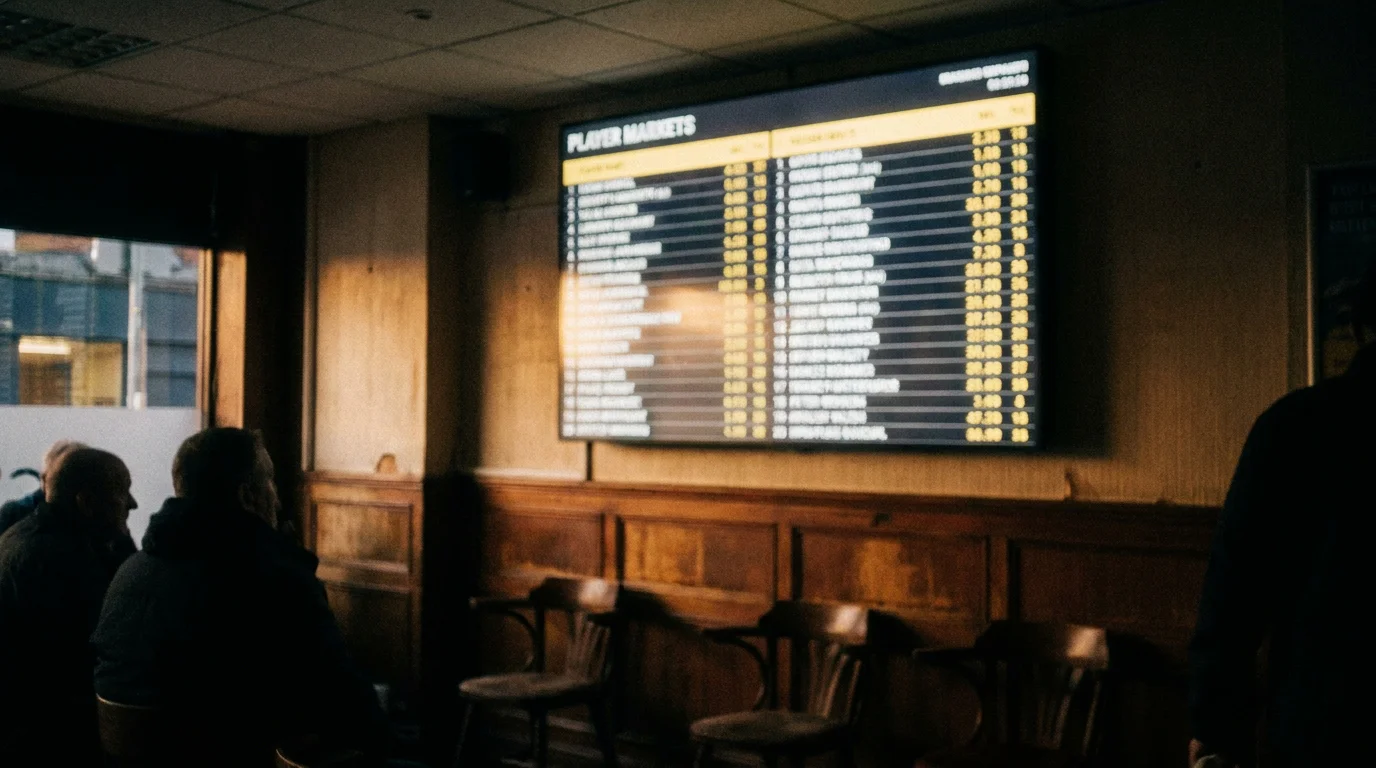
Second-line forwards on top teams price at 3.5 to 5.5. Their lower power-play time and lower line minutes reduce the goal probability relative to first-line names. The trap on second-line ATG: the price often looks attractive at 4.5 or 5.0, but the actual probability is sometimes 18 percent or lower against a strong defensive opponent. Always check the line deployment before backing second-line ATG.
Third-line and bottom-six forwards price at 6.0 to 12.0. These are coin-flip bets at best — the implied probability is below 15 percent and the variance is enormous. Bottom-six ATG is best left alone unless the player has a specific role advantage (penalty-kill specialist who’s also seeing power-play time, for instance) that the book hasn’t fully priced.
The NHL produced $6.5 billion in revenue across the 2024-25 season, and the betting product depth has scaled with that revenue. UK books now post ATG on every NHL skater in every game, with prices updating until puck drop based on lineup confirmations, line deployments and goalie announcements. The prop has gone from a top-of-card headline market to a full menu in a single decade.
Selection logic: what actually predicts a goal
Goal probability is driven by four factors, in roughly this order of importance.

Power-play unit. The first power-play unit gets the heaviest goal-scoring opportunities. A player on PP1 with elite teammates produces 30 to 40 percent of his goals on the power play. Identifying who’s on PP1 in any given game — and whether the team is likely to draw multiple power plays — is the foundation of ATG selection.
Time on ice. A forward getting 19 to 22 minutes per game produces meaningfully more goal chances than a forward getting 14 to 16 minutes. The leading skaters in the NHL, particularly the centres, can push close to 23 minutes per game. Tage Thompson of the Buffalo Sabres recorded the NHL’s top shot speed in the 2024-25 season at 106.00 mph — that kind of release combined with heavy minutes produces the goal frequency that makes ATG profitable. Pure ATG selection without TOI awareness misses how much line deployment drives the outcome.
Opposing goalie save percentage. A starting goalie with a .920 save percentage against a starting goalie with .900 produces a 20-point difference in the probability of any single shot becoming a goal. The opponent’s identity matters more than the lay punter realises. ATG on McDavid against the Ducks is a different bet than ATG on McDavid against the Bruins, even if the line is on the same player.
Opposing penalty kill. A team with a 75 percent PK rate concedes a lot of power-play goals. ATG on a power-play specialist against a leaky PK is structurally favourable. The kill rate is publicly available and updates weekly; using it as a filter on ATG selections improves the strike rate measurably.
Traps: where ATG kills bankrolls
The biggest trap is the overtime-game on a top star. McDavid plays in a 3-3 game; the game goes to OT; McDavid touches the puck for 80 seconds of OT and the game ends 4-3 the other way. Your ATG ticket loses. McDavid was a heavy ATG favourite at 1.9, but he didn’t score. Hockey OT is 3-on-3 and short, and even the league’s best players miss OT goals constantly.

Empty-net concentration is another trap. When a team is trailing by one with three minutes left and pulls the goalie, the empty-net opportunity goes to whoever’s on the ice for the defending team. That’s often a defenceman or a bottom-six grinder, not the top star you bet ATG on. The empty-net goal counts toward ATG, but it doesn’t go to the player you backed.
The EIHL version: thinner market, different logic
EIHL anytime goalscorer is available on UK books for headline players — top scorers on the leading EIHL teams. Quoting that the partnership with EA Sports and NHL EDGE is about more than just numbers and is about bringing the soul of the game to life captures something the EIHL market still lacks: that depth of data integration. EIHL ATG pricing relies on basic season production rather than the data-heavy modelling that drives NHL ATG, which produces wider lines and occasional value spots.

The deeper prop that pairs with ATG
Anytime goalscorer measures whether a player scores; shots on goal measures how often a player attempts to score. The two markets are structurally related — high SOG produces high ATG strike rates over time — but they’re priced independently and the EV opportunities diverge. The full breakdown of the SOG market is in our shots on goal props analysis, and the pairing of ATG and SOG is where most of the prop-betting EV in hockey actually lives.

Articles
Prepared by the hockeybetonline.com editorial staff.
